I live on the southern end of the Atlantic coastline in South Carolina. As a photographer, I am always looking for ways to capture the unusual. The area is rich with places to capture sunrises and moonrises over the beautiful beaches of the Atlantic Ocean and the marshes of Murrells Inlet. Capturing the sunrise, moonrise and milky way is usually my go-to, hoping to grab something unusual, something unique.
These areas have become the favorite stomping grounds of many photographers in the area, each capturing their own beautiful creations, some looking the same as others but all unique captures. Each one captured is different as it is God's art as seen through the lens of the individual, unique photographer who captured it.
Vision
Each photographer has their own vision when capturing something with their camera. They "see" something in their mind and want that vision to translate onto the flat media card in their camera. Photographers have ways to accomplish that in camera. They change where they're standing, or get low to the ground, or get close-up or use a physical filter on their lens. They slow the shutter speed down to produce creamy smooth ocean water or sky. They use a large aperture to accomplish a small depth of field, allowing a buttering soft, blurred background to make their subjects pop in the image.
Photographers do as much as possible with their camera to realize their vision. Its hard. Humans see with depth. We see three dimensional and we're trying to relay that onto one dimension, hoping it looks the same as our eye sees it. They compose their image to have layers in the landscape or portrait so that there is are purposefully placed objects in the image to create and illusion of three dimension.
Sometimes we need to bring our vision to life after capturing the image. We know what we saw and felt at the time we were capturing that image. But when we see it on a one dimension medium like a laptop screen, it is flat and doesn't grab us like the true to life experience.
Processing
In the film days, even well known photographs such as Ansel Adams would modify his images with dodging and burning in the darkroom. From his Wikipedia page "By 1925 he had rejected pictorialism altogether for a more realistic approach that relied on sharp focus, heightened contrast, precise exposure, and darkroom craftsmanship."
Most professional and hobbyist digital photographers shoot in a RAW format. In simple terms, shooting in RAW format basically allows all data into the camera once the shutter is opened until it closes, regardless of the settings on the camera.
We, as photographers, adjust our settings manually to accomplish what we want to see in the image. We'll adjust shutter speed (how fast the shutter opens and closes to let in the light and image), aperture (how large the shutter opens) and ISO (how sensitive the media is to the light let into the camera). All three settings dictate how the image will "look" along with focus and focal point.
When we set these settings, it is part of what we do to accomplish that vision we're seeing with our eyes. But the camera is collecting so much more than what our settings are telling it to. It actually creates two "files" when we shoot in RAW. It collects all the data that pours into the open shutter and it creates a smaller .jpg file within the RAW file that has all of our settings applied. This small .jpg file within the RAW file is what we "see" on the camera's viewfinder. It is how the CAMERA interpreted the settings.
But the camera is not human. It doesn't see what we see and it doesn't know our vision. And that is why the RAW data is so important. We, as photographers, use that RAW data in post processing to accomplish our vision. To reflect on that one dimensional medium what we saw with our three dimensional eyes.
Unique Subjects
Our temperatures in South Carolina are generally mild and it is rare that we'll ever see frozen precipitation or snow. This past weekend, however, we had a cold blast roll in from the west, bringing precipitation with it. It was predicted to be a frigid weekend with mostly freezing rain and ice but a chance of a little snow. I was not looking forward to that. The mild climate, after all, was why I moved from Washington DC Metropolitan area to Myrtle Beach South Carolina.
When I saw that our outside temperature was going to be 19 degrees on Sunday morning, I was ecstatic despite hating cold weather. I would get a chance to create and photograph ice bubbles! Ice bubbles are exactly what it sounds like. They are bubbles like kids blow in the air that land on a surface and freeze. Sounds easy, right? I found it was not so easy.
To create the bubble solution, you use six parts water, three parts dish soap and one part clear corn syrup or glycerin. The corn syrup is what will help keep the bubbles from popping.
So I created the solution the night before. In hindsight, I should've put it in the refrigerator or freezer to cool down. The next morning, pre sunrise, all decked out with head and ears covers, gloves and winter coat and boots on, armed with my camera and soap solution, and headed to the beach which is less than 10 minutes from my home.
When I got to the beach, it was empty. It was, after all, only 19 degrees. The sun had still not broken the horizon so I began to figure out where I want to make my bubbles.
I tried a couple test areas, on the sand (frozen sand) and into/onto the now-dead, brown sea oats. All my bubbles broke on contact. I began to get disappointed.
I retreated back onto the decking walkway to "regroup", pretty cold at this point. The sun had broken the horizon so I grabbed some shots of it. The sunrise was very interesting. The ocean water temperature remains 50 degrees and higher so as the sun rose, you could see the steam rising from the water that was warmer than the air.
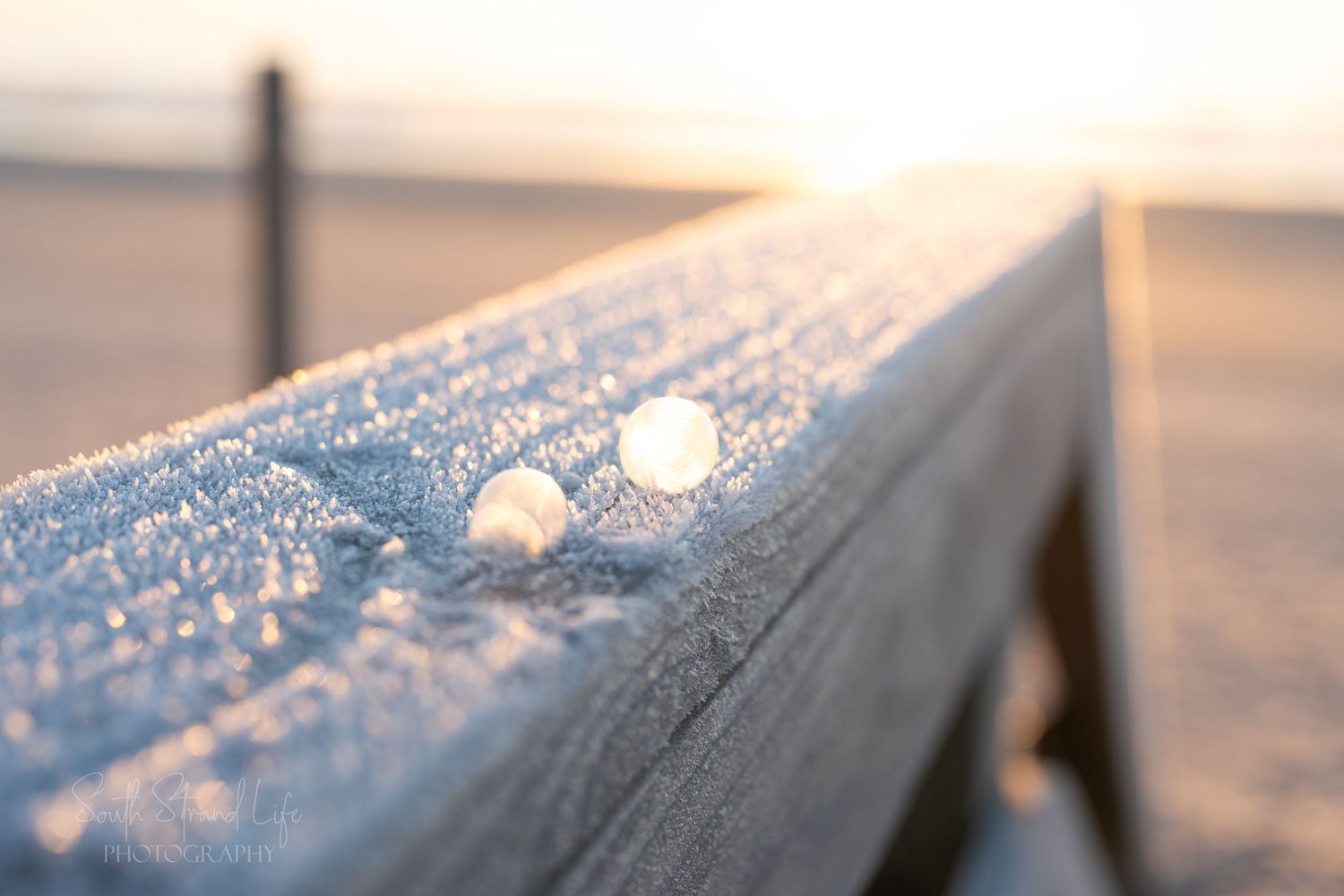
Ice Bubbles Photoshoot, Straight out of Camera, Over exposed capture in bright sunlight
SOOC
The above is an example of getting it wrong "in camera". When I retrieved it from the camera, I was disappointed. I seemed to have missed focus, my aperture was too open so that my depth of field only allowed for a very small depth of focus field. My exposure was way off, partly because the aperture was wide open, letting in a lot of light.
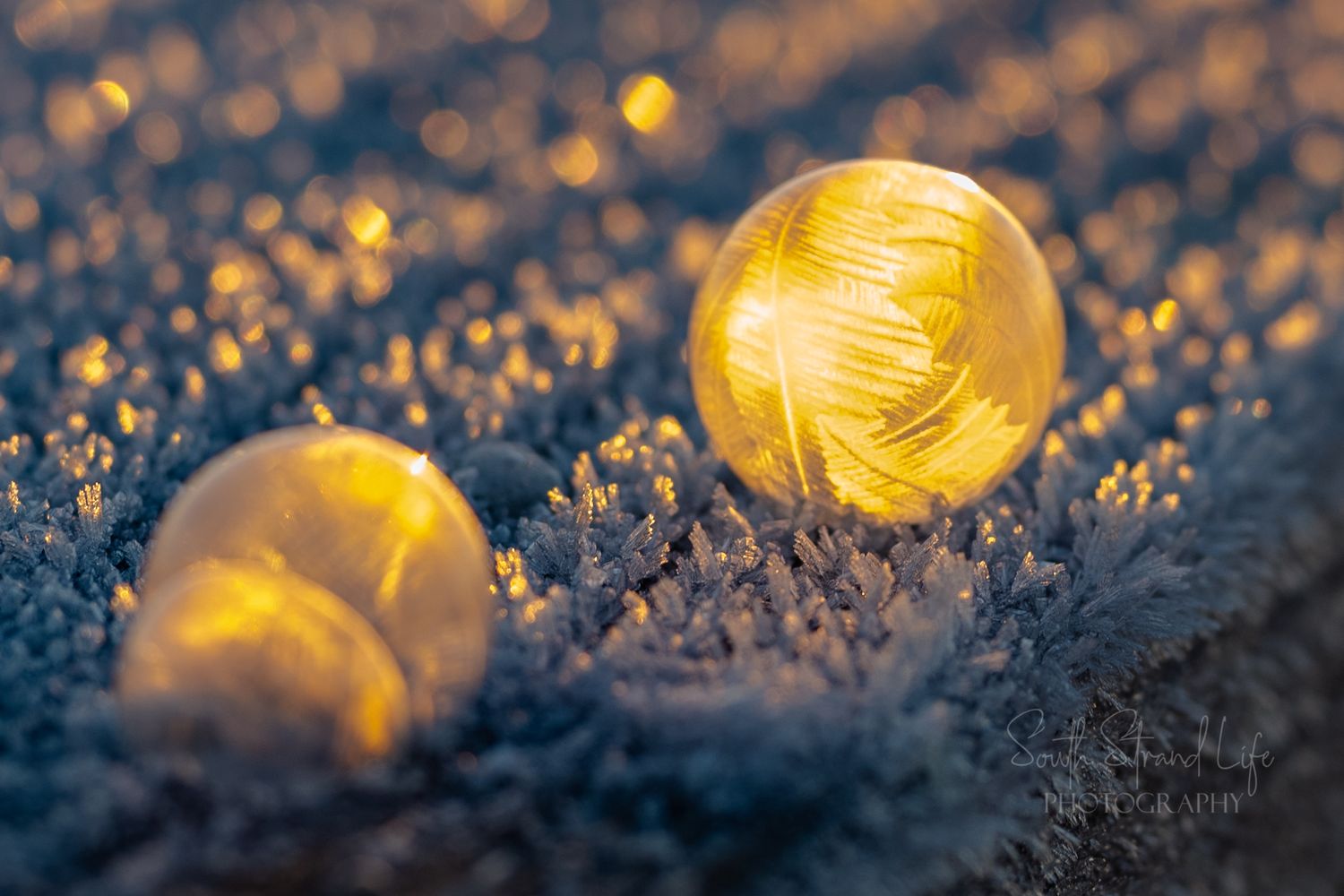
Frozen ice bubbles, First edit, not much effort and it showed!
First Edit
Since my primary subject was the ice bubble, I decided to concentrate on just the bubble and crop the image heavily. I then began the process of "saving" the image. Looking at the SOOC, you may think it was unsavable. Remember, I shot it in RAW format and what you see in the SOOC was how the camera interpreted the data received based on my seriously incorrect camera settings. The first attempt was not a wow moment but it was presentable and even could be called "good".
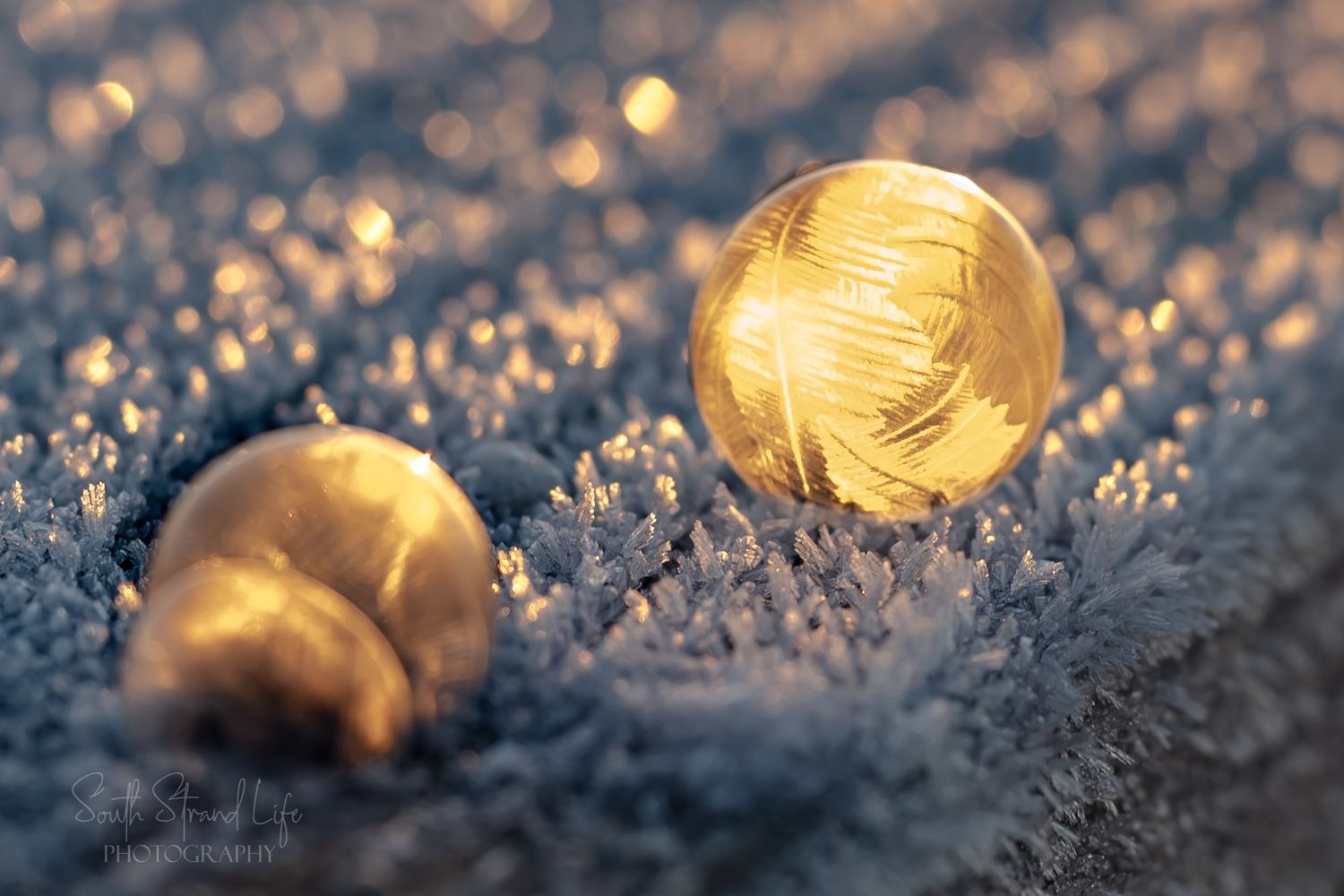
Ice bubble, second edit. More clarity but still not what I was "seeing".
Second Edit
I wasn't very happy with it. I felt the bubble itself was not in focus and was thinking maybe it was the best I was going to get.' I took another look, though. I started with the SOOC, created a virtual copy and began editing.
I raised Highlights and lightened the Blacks to get the snow how I remembered it. I then used an adjustment brush to select just the bubbles. On the bubbles only, I increased Contrast and Highlights. I also bumped Texture, Clarity and Dehaze. These adjustments really brought out the detail of the bubbles. The bubbles in the front were purposely out of focus because I had pinpointed on the main bubble. I liked this edit.
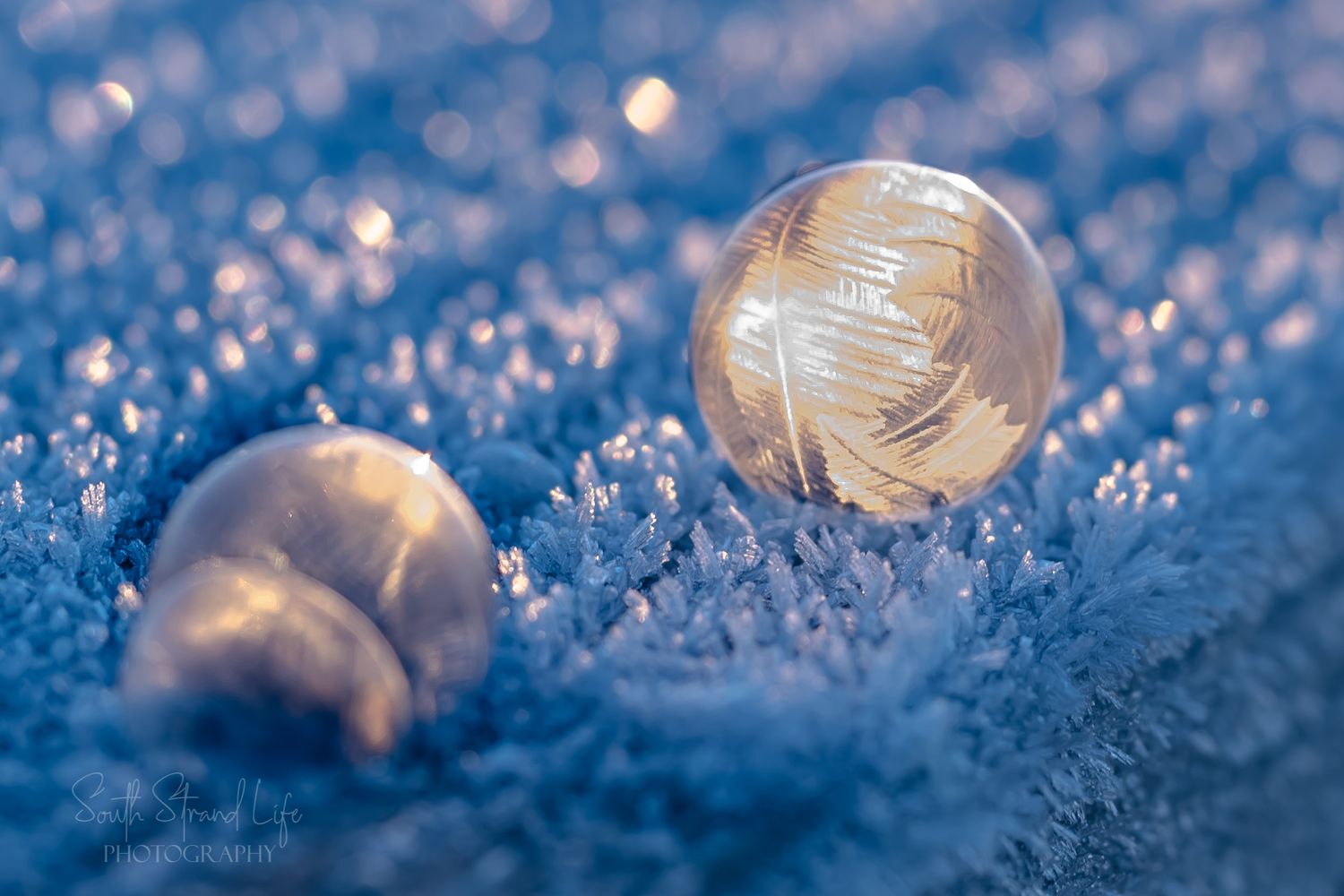
Ice bubble, Final edit, cooler, closer to how I actually saw it in person.
Final Edit
When I looked at the second edit, I still felt there was more I could do to bring what my eyes actually saw versus what was on the media.
I felt like the bubbles, although lit by the sun now higher in the sky, were not actually as yellow as I was seeing in the edits. Then I looked back at the SOOC and brought the white balance temperature back down to a cooler place. This also brought the snow/frost to a cooler place, more realistic to how it actually was.
Yes, this was much more representative of my my human eyes saw in person!